

The data and findings discussed here come from the cited paper and do not represent test results from VISPEK equipment.
Whether a germplasm screening model can be used across years requires separating completely independent new-year predictions from updated results after adding current-year samples. Updates may improve performance but also change validation conditions.
This black cumin seed study used HPLC thymoquinone as a reference paired with whole seed spectra, focusing on cross-year verification and continuous calibration sample supplementation.
Summary
The study collected reflectance spectra of black cumin seeds over multiple years, establishing a model with HPLC thymoquinone content as reference, and first used earlier years to predict the following year. Cross-year prediction had some effect; adding new-year samples improved performance, but the updated results were no longer a completely independent cross-year validation. The original model relied on longer wavelength ranges and does not support efficacy conclusions.
(AI-generated conceptual illustration for context; it is not data from the paper, a photograph of the research equipment, or a VISPEK product diagram.)
Why It Matters
Cross-year validation demonstrates the real drift in seed component screening, providing an example for annual review of high-content breeding materials.
Methods and Reference Measurements
The breeding single plants in 2021/2022/2023 were 288/313/179 samples, totaling 780. About 300 mg of whole seeds were scanned at 400–2500 nm with 2 nm intervals; 30 mg of seeds were extracted with 70% methanol for 16 hours, followed by C18-HPLC and 254 nm detection using a thymoquinone external standard. SNV/detrending/second derivative, 1100–2500 nm MPLS; the model from the previous two years was used to predict the third year, then 25%/50% of the new year samples were added to verify the remaining samples, path length not reported.
Wavelengths and Acquisition Parameters
| Band/parameter | Original meaning and usage instructions |
|---|---|
| 1100–2500 nm | Modeling excluded 400–1100 nm, MPLS used the remaining NIR. |
| Approximately 2106, 2254 nm | Key wavelengths related to thymoquinone discussed in the paper. |
Key Findings
The first two years’ model independently validated in the third year: r² = 0.85, bias-corrected SEP = 1.18 mg/g; including samples from the current year improved predictions. Updated results should not be considered fully cross-year independent.
Limitations and Interpretation
The thymoquinone model involves long-wave information such as 2106 and 2254 nm; the study only provides evidence for chemical content screening, not for efficacy conclusions.
Band and model boundaries: The original model uses out-of-range information; the validity after deleting out-of-range data has not been verified this time, and the original results cannot be copied or the target range equipment can be claimed to be reproduced.


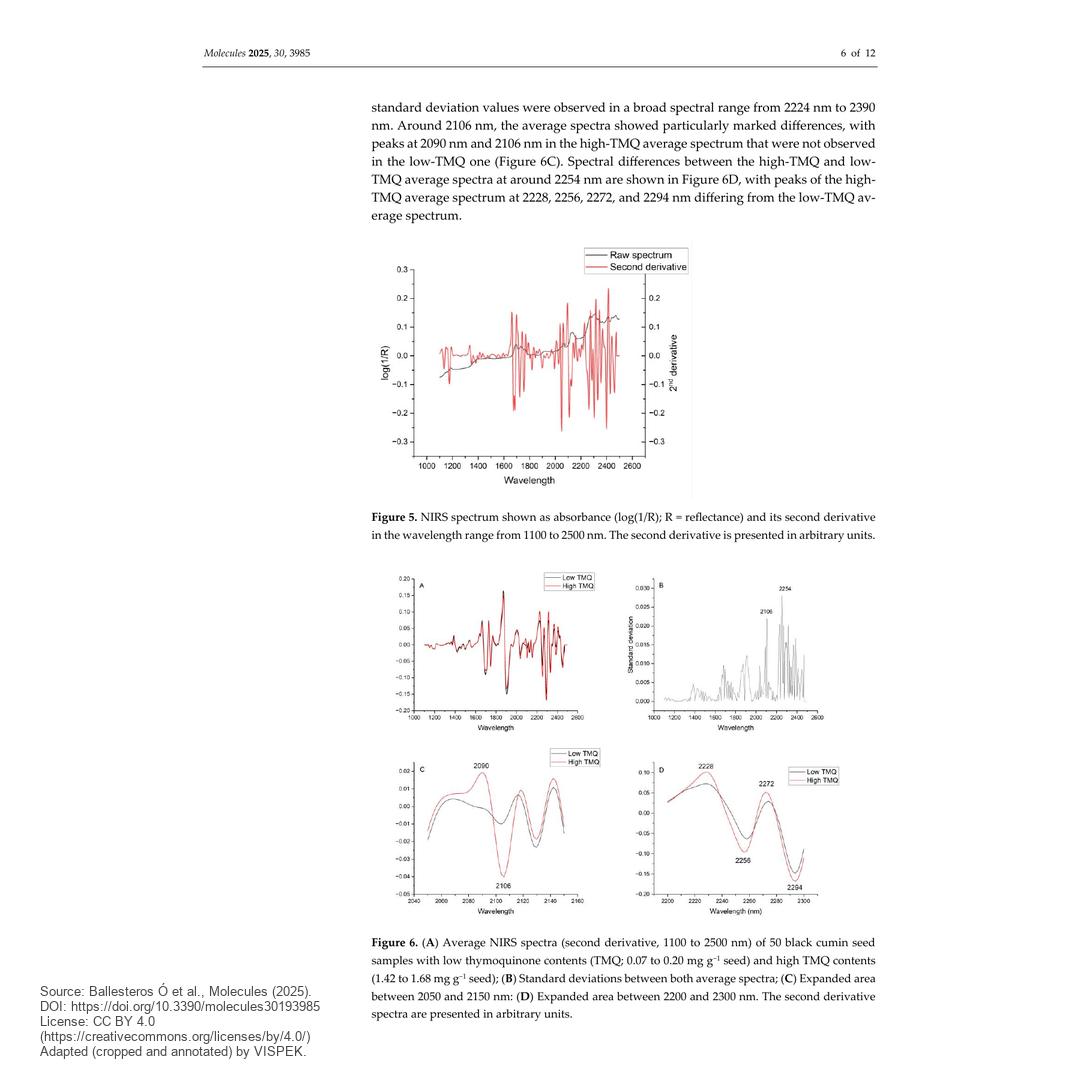
Image copyright belongs to the paper’s original authors. License: CC BY 4.0.
Source Paper
Ballesteros Ó, Velasco L. (2025). Analysis of Thymoquinone Content in Black Cumin Seeds Using Near-Infrared Reflectance Spectroscopy. Molecules (Basel, Switzerland). https://doi.org/10.3390/molecules30193985
Contact Us
Whether portable equipment can be used for similar detection needs to be evaluated based on samples and experimental conditions, and the specific effect still needs to be verified through actual testing. Welcome to contact VISPEK to exchange your sample and testing needs, jointly evaluate experimental plans, and explore the feasibility of using our company's equipment for actual measurement and verification.
- Email: contact@vispek.cn
- Website: https://www.vispek.cn

VISPEK products shown for illustration; these were not the devices used in the cited study.