

The data and findings discussed here come from the cited paper and do not represent test results from VISPEK equipment.
The preparation and use of deep eutectic solvents require understanding of moisture changes. If the measurement is transferred from desktop equipment to handheld instruments, the stability and applicable formula need to be re-confirmed. This study compares various vibrational spectroscopy methods individually, with the handheld near-infrared transmission branch providing a reference with clear test boundaries.
Summary
The study compares multiple vibrational spectroscopy methods on independently prepared deep eutectic samples. The hand-held NIR-H transmission branch optimizes PLSR in some groups and tests the predictions in independent groups. Its results are reported separately from the wide-spectrum desktop NIR-B. The good performance is limited to the tested formula of levulinic acid and proline and the range of water addition. The relative error of low concentration and the issue of formula replacement still need to be considered.

(AI-generated conceptual illustration for context; it is not data from the paper, a photograph of the research equipment, or a VISPEK product diagram.)
Why It Matters
Converting changes in solvent moisture content into repeatable transmission signals helps bring formulation consistency checks to the process site.
Methods and Reference Measurements
Five groups were prepared using a levulinic acid/L-proline deep eutectic system, with nine water addition levels per group, for 45 independent samples. NIR-H measurements used a handheld transmission instrument and glass vials over 900–1700 nm, with repeated scans for each sample. Two groups were used to optimize the PLSR model, and the other three to assess prediction. Results were compared separately with broadband NIR-B and other instruments, without mixing the results of the different experimental branches.
Wavelengths and Acquisition Parameters
| Band/parameter | Original meaning and usage instructions |
|---|---|
| 900–1700 nm | NIR-H handheld transmission branch acquisition range |
| About 1111–1667 nm | The 9000–6000 cm⁻¹ area used in this article to demonstrate and explain handheld hoses; NIR-B scores are not awarded |
Key Findings
NIR-H in the independent test group R²=0.9984±0.0002, RMSEP=0.68±0.08% w/w water addition; the average relative error is 6.23%. NIR-B is a wide spectrum desktop instrument, not a handheld branch of this case.
Limitations and Interpretation
For a deep eutectic formula and a specified water addition range; the relative error will be amplified at low concentrations, and the relationship needs to be rebuilt after changing the formula.
Band and model boundaries: Only the 900–1700 nm handheld NIR-H branch is used; NIR-B and ATR-IR results are not included in this case.
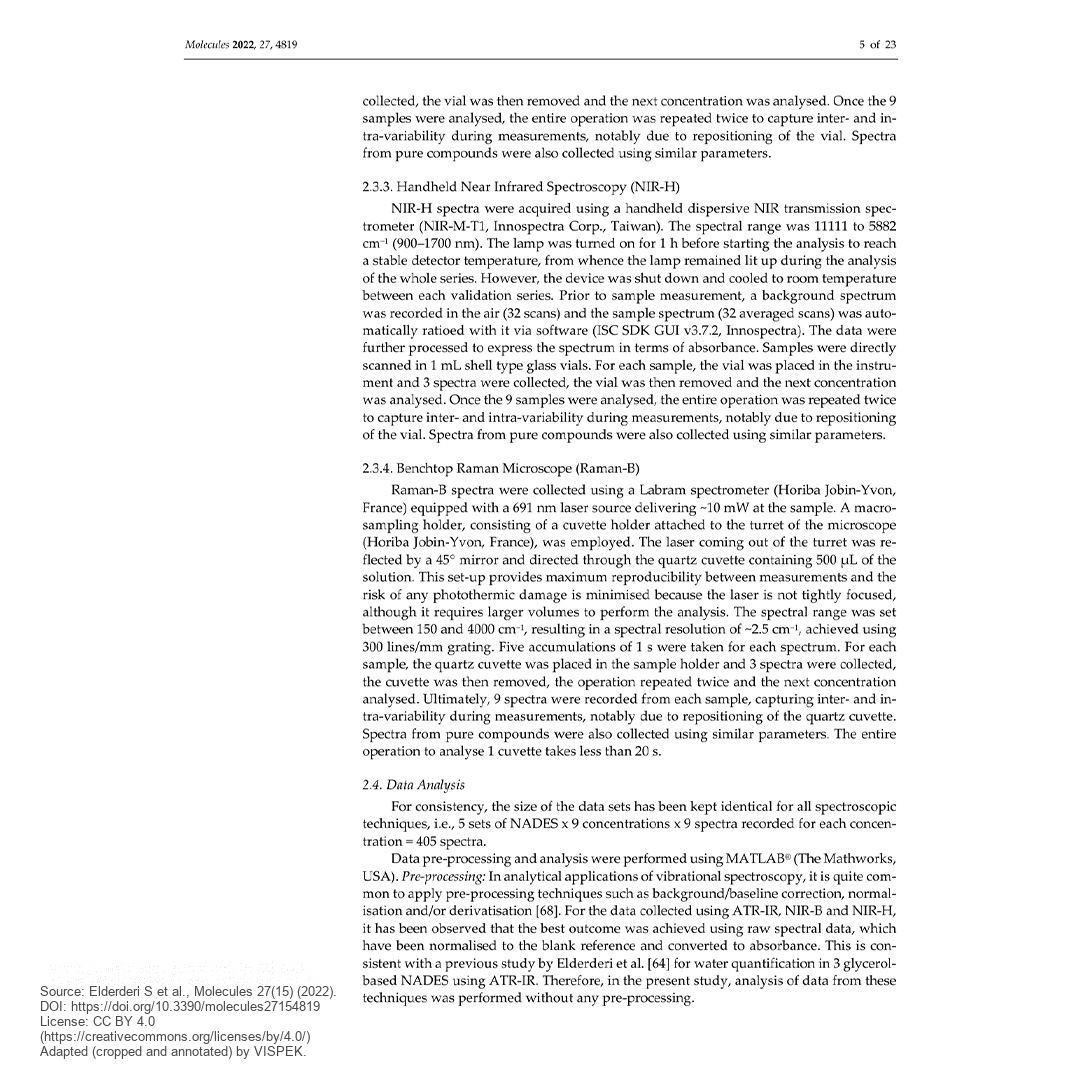


Image copyright belongs to the paper’s original authors. License: CC BY 4.0.
Source Paper
Elderderi S, Sacré PY, Wils L, Chourpa I, Elbashir AA, Hubert P, Byrne HJ, Boudesocque-Delaye L, Ziemons E, Bonnier F. (2022). Comparison of Vibrational Spectroscopic Techniques for Quantification of Water in Natural Deep Eutectic Solvents. Molecules 27(15). https://doi.org/10.3390/molecules27154819
Contact Us
Whether portable equipment can be used for similar detection needs to be evaluated based on samples and experimental conditions, and the specific effect still needs to be verified through actual testing. Welcome to contact VISPEK to exchange your sample and testing needs, jointly evaluate experimental plans, and explore the feasibility of using our company's equipment for actual measurement and verification.
- Email: contact@vispek.cn
- Website: https://www.vispek.cn

VISPEK products shown for illustration; these were not the devices used in the cited study.