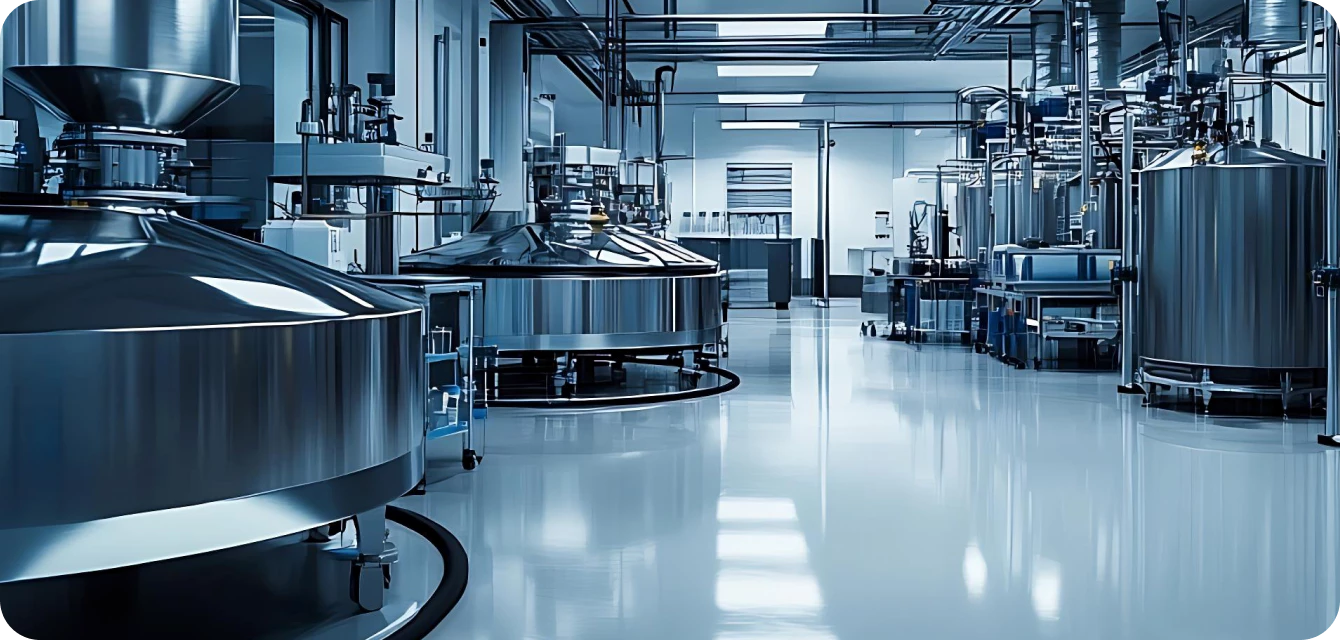
Sodium hydroxide tank outlets and brine transfer pipes
Data updates
The case describes updates every 15 seconds, displayed on the production console
The challenge
Data Lag Hinders Production Control
Traditional laboratory testing methods cause data delays, failing to support real-time production parameter adjustments.
Read background
Sodium hydroxide and brine salt concentrations require manual sampling and lab analysis, taking at least 40 minutes from sampling to results. For instance, in a sodium hypochlorite production workshop, a brine sample taken at 8 AM only yielded salt concentration data by 9 AM. During this period, brine continued to flow into the electrolytic cell, could not guide salt addition adjustments timely.
High-Risk Sampling Poses Safety Threats
Manual sampling need to direct contact with raw chemical materials, presenting risks of corrosion.
Read background
Sodium hydroxide is a strong alkali, and while less corrosive, brine can reach temperatures of 60-80°C. Sampling requires opening pipeline valves, where a slight misstep can result in burns from splashed liquids. There is a case that a worker sampling sodium hydroxide dropped a reagent bottle, causing the solution to splash onto their arm, resulting in second-degree burns and a 15-day work stoppage for treatment.
Delayed data leads to untimely production parameter adjustments, compromising product quality stability.
Read background
In sodium hypochlorite production, sodium hydroxide concentration must remain at 30%-32%, and brine salt concentration should be controlled at 280-300g/L. Deviations can cause incomplete reactions. Due to data lag, there is a case that a company produced sodium hypochlorite using non-standard brine for two hours, resulting in effective chlorine content 15% below standard, leading to rework the whole batch.
How it works
Pressure-Resistant and Corrosion-Proof Integration at Critical Process
Precisely tailored for sodium hypochlorite production, specifically monitoring sodium hydroxide raw material concentration and brine salt concentration. The equipment features a pressure-resistant and corrosion-proof design, allowing direct installation at key locations such as sodium hydroxide storage tank outlets and brine pipelines. It withstands acid-alkali mist and high temperatures in the production environment, adapting to sodium hypochlorite production lines of varying scales.
Concentration updates every 15 seconds
Replaces traditional manual sampling and laboratory testing, enabling real-time online concentration detection. High-precision sensors directly interact with raw materials without manual intervention, updating data every 15 seconds and displaying it on the production console's monitoring interface for intuitive tracking of concentration changes.
Dynamic Threshold Alerts for Precise Control
Continuous data collection provides real-time guidance for dynamic production parameter adjustments. When sodium hydroxide concentration falls below 30%, the system automatically triggers an audiovisual alarm and displays "Recommend adding high-concentration sodium hydroxide" on the interface. If brine salt concentration drops below 280g/L, it prompts "Increase salt input," guiding immediate adjustments.
What changed
Paradigm Shift in Testing Cost Reduction
Significantly saves testing time and costs, reducing labor and consumable expenses. Conventional testing requires two lab technicians working in shifts, with daily consumable costs for reagents and test tubes around 300 RMB. After implementation, no dedicated technicians are needed, and consumable costs drop to under 500 RMB per month, saving over 100,000 RMB annually per factory. Testing time is reduced from 40 minutes to real-time results.
Parameter Stability Enhances Quality Control
Real-time parameter adjustments minimize quality issues caused by deviations, improving product quality. With immediate data-driven adjustments, sodium hydroxide concentration stabilizes at 30.5%-31.5%, and brine salt concentration at 285-295g/L. The effective chlorine content qualification rate for sodium hypochlorite rises from 82% to 98%, with rework rates dropping by 90%.
Elimination of High-Risk Operations Reshapes Safety Baseline
Eliminates manual sampling risks, enhancing operational safety and protecting worker health. By removing manual sampling, raw material exposure risks are completely eliminated. Over the past year, no chemical burn incidents have been reported among adopting companies, significantly boosting workers' sense of safety and reducing staff turnover by 30%.
Reported results describe this project and its operating conditions. Suitability for your application requires evaluation of your sample and installation.
Let's talk about your application
What would you like to measure?
You don't need a finished specification. Tell us about your sample and the problem you want to solve.
The material or sample you work with
The measurement you need
Where you plan to use it
Prefer to contact us directly?
bd@vispek.cn
International sales
+86 187 8028 5542
China sales
+86 186 6590 3209
Office
+86 755 2665 1125
Office address
Room 501, Building K, North Zone, Qianhai Shenzhen-Hong Kong Youth Innovation Hub, 5188 Menghai Avenue, Shenzhen, China